India’s EV ecosystem is rapidly evolving. As electric mobility takes center stage, knowing what a DISCOM is and why EV station owners must understand it is becoming a key factor shaping the future of infrastructure and investment. For entrepreneurs and investors stepping into the EV charging space, grasping the role of Distribution Companies (DISCOMs) is the critical first step toward building a profitable and resilient business.
The Big Picture: A Major Shift in EV Infrastructure
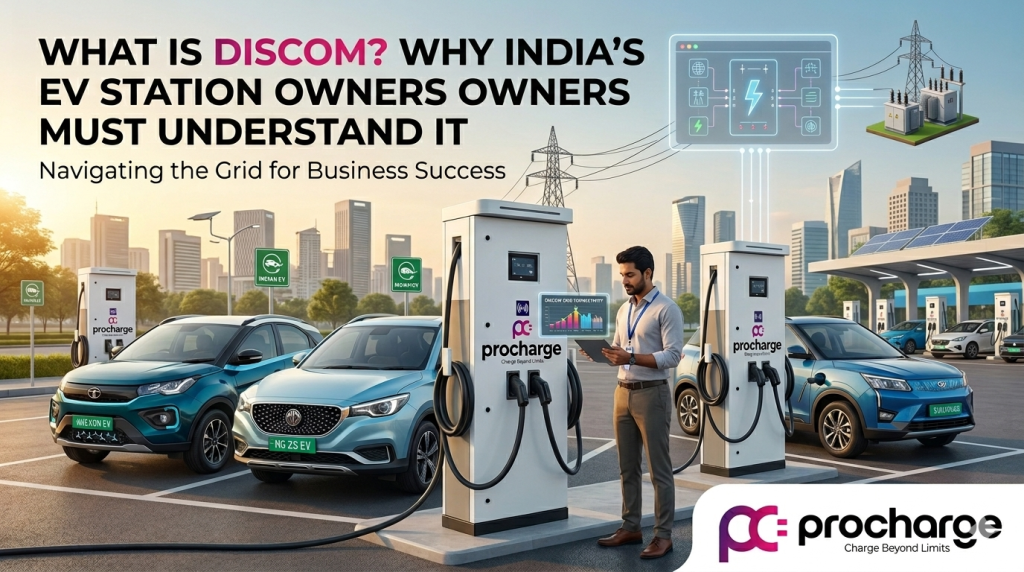
A DISCOM is the local utility company responsible for purchasing power from generators and distributing it to end consumers—including EV charging stations. This topic highlights a major shift in how EV charging is deployed, monetized, and scaled across India. Securing a reliable connection, managing load capacities, and understanding EV-specific electricity tariffs all depend heavily on your relationship and coordination with the local DISCOM.
Business Impact for Operators and Investors
Navigating the technical and regulatory frameworks of local power distributors directly impacts the bottom line. For operators and investors, this means better cost efficiency, new revenue streams, and scalable infrastructure models. By aligning charging operations with favorable DISCOM policies—such as Time-of-Day (ToD) tariffs or specialized EV energy rates—station owners can drastically lower their operational expenditures while offering competitive rates to EV drivers.
Key Opportunities in the Market
Understanding grid capabilities and local power policies allows smart operators to strategically plan their network rollouts. This knowledge unlocks several powerful opportunities:
While the market is ripe for growth, setting up a robust EV charging network is not without its hurdles. Business owners must be prepared to carefully manage the following obstacles:
Policy variations across states.
Infrastructure investment costs.
Grid and DISCOM coordination.
Traditional vs. Modern EV Charging Models
To overcome these challenges and maximize profitability, operators must look past outdated operational methods. Traditional vs Modern EV Charging Models show clear advantages in flexibility, pricing, and scalability. Modern charging infrastructure incorporates smart load management, which allows stations to communicate efficiently with the grid, adapt to power constraints, and dynamically adjust pricing—keeping both the DISCOM and the consumer satisfied.
Key Insights for the Future
As India’s electric vehicle infrastructure continues to mature, a few foundational truths are emerging for industry stakeholders:
EV charging is now a revenue-generating asset.
Early adoption gives a long-term advantage.
Policy support is accelerating growth.
Conclusion
The shift toward electric mobility is fundamentally transforming India’s transportation and energy sectors. Understanding how to work alongside local DISCOMs is the secret to building a sustainable, profitable charging network. Businesses that act early will benefit the most from this transition.
Take the Next Step Partner with Procharge to deploy scalable EV charging infrastructure.