- contact@procharge.in
- Open Hours : Mon - Sat 10:00 AM - 06:00 PM
- +91 7010 040 060
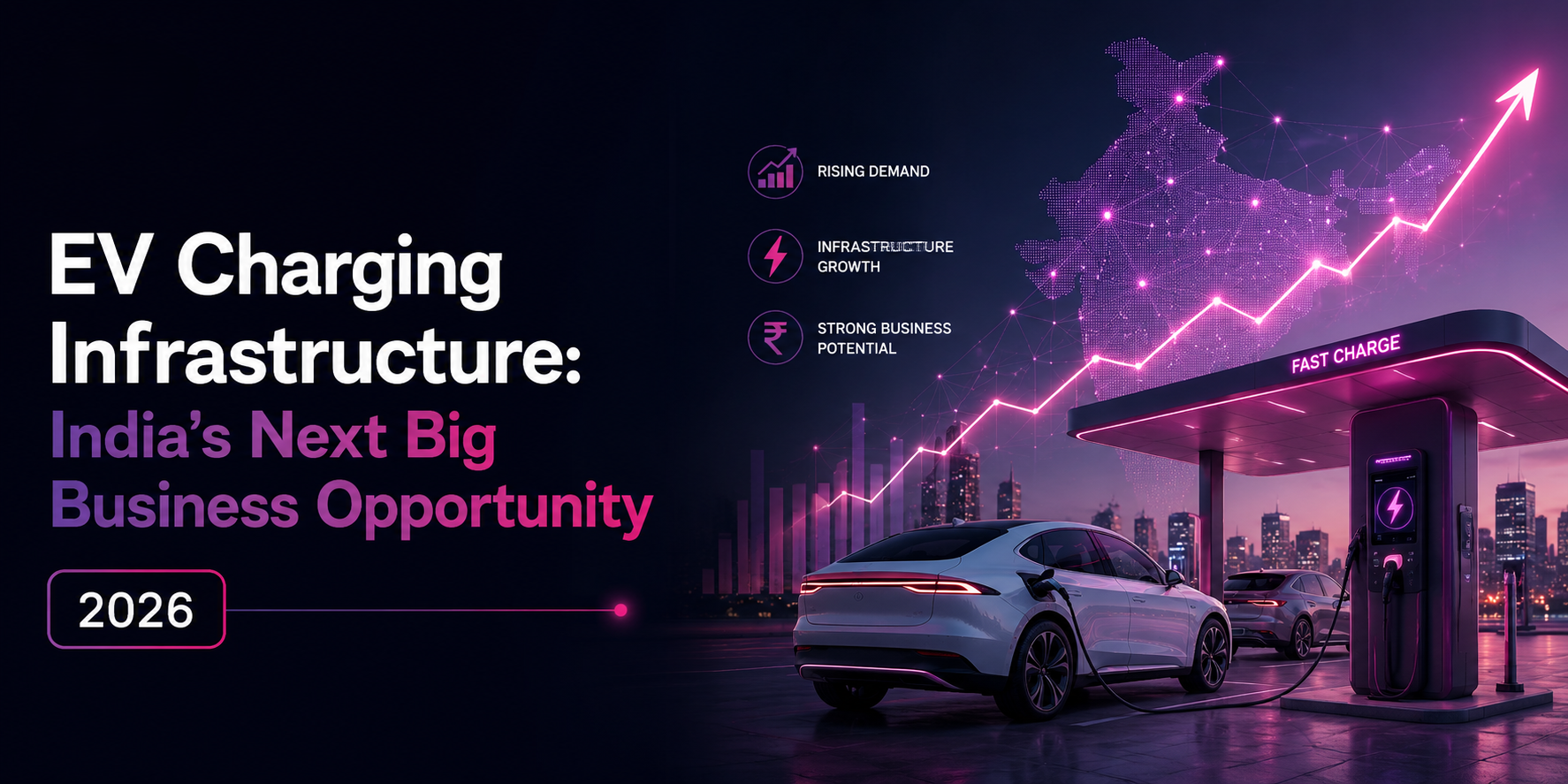
India added roughly 24.5 lakh new EVs in FY2025-26. It has about 29,000 public charging stations. By 2030, estimates from the Confederation of Indian Industry suggest the country will need 1.32 million charging stations — requiring around 4,00,000 new installations every single year to close the gap.
That is not a projection designed to make a business pitch sound good. It is a straightforward infrastructure problem, stated plainly by industry bodies and government planning documents. The EV fleet is growing. The charging network is not keeping pace. And unlike most infrastructure deficits, this one is legally open to any private operator, investor, or property owner who wants to participate.
That last part matters more than most people realise.
Setting up a petrol station requires an oil company partnership, state licensing, and years of regulatory clearance. Building a power plant requires distribution licences and massive capital. Most energy infrastructure in India is either government-controlled or tightly restricted.
EV charging is deliberately different. The Ministry of Power classified EV charging as a de-licensed activity in 2018 — meaning any individual or entity can set up and operate a public charging station without a special licence. No approval from the electricity regulator, no distribution licence, no oil company partnership. The government made this choice specifically to attract private participation and accelerate network buildout.
The DISCOM is required to provide an electricity connection within seven days in metropolitan areas and fifteen days elsewhere. That connection timeline is mandated — it is not at the distribution company’s discretion. This removes one of the biggest bottlenecks that typically slow infrastructure investment.
The EV business opportunity argument sometimes gets dismissed as “too early” or “future demand.” In India in 2026, that objection is no longer valid.
Electric vehicle penetration crossed 8.5% of total vehicle registrations in FY2025-26. Passenger car EV sales surged 77% in 2025 alone. Two-wheelers and three-wheelers — which make up nearly 87% of India’s EV volumes — crossed 1.04 lakh monthly registrations for two-wheelers. The customer base is not hypothetical. It is on the roads right now, using your competitors’ chargers, and it is growing every month.
The India EV charging station market was valued at approximately USD 589 million in 2025 and is projected to reach USD 1,652 million by 2030, growing at a CAGR of 27.67%, according to Marqstats’ March 2026 market report. More practically: public charging stations consumed approximately 847.8 million units of electricity in FY2024-25 — more than four times the level reported the year before. Utilisation is rising alongside station count.
That electricity consumption figure is important. It is not theoretical capacity — it is actual energy dispensed, actual revenue generated, by actual EV owners who charged their vehicles. The market is operating, not waiting.
Government support for EV charging infrastructure has been growing, but the 2024-26 period specifically is notable for the scale of financial commitment.
The PM E-DRIVE scheme allocated ₹2,000 crore specifically for EV charging infrastructure deployment, targeting 72,000 public chargers. State-level capital subsidies of 20 to 25% are available in Karnataka, Tamil Nadu, Maharashtra, and several other states. The GST on EV chargers was reduced from 18% to 5%, meaningfully reducing the cost of hardware procurement. Concessional electricity tariffs — typically ₹5 to ₹6.50 per kWh compared to standard commercial rates — are available in every major state.
These schemes have expiry windows and availability constraints. The operators entering now capture subsidy support that may not be available in the same form in two or three years.
Revenue in an EV charging business has a primary stream and several supplementary ones.
Primary: Per-kWh charging fee. At current public rates of ₹12 to ₹25 per kWh (depending on AC vs DC and location), against a concessional electricity input cost of ₹5 to ₹6.50 per kWh, the gross margin per kilowatt-hour is roughly ₹6 to ₹12. A well-located DC fast charger running at reasonable utilisation can generate ₹60,000 to ₹1,00,000 per month in gross revenue.
Fleet contracts. Signing a monthly or annual charging contract with a fleet operator — an e-commerce delivery company, a cab aggregator, a corporate shuttle service — provides predictable, anchor revenue that reduces the impact of public utilisation variance. A single mid-size fleet contract can stabilise the economics of a new station in its early months.
Advertising and co-location. Charging stations create dwell time. A driver charging for 30 minutes is a captive audience. Advertising revenue from digital screens at the station, co-located F&B or retail, and partnership arrangements with nearby businesses are increasingly common supplementary income streams for high-traffic stations.
Carbon credits. EV charging stations that can document their energy consumption and carbon savings are starting to participate in voluntary carbon credit markets. This is an early-stage revenue stream in India but is likely to become more material as sustainability reporting requirements grow for businesses.
India has 29,000 public charging stations spread across 849 cities. That sounds significant until you compare it to the 1.3 million needed by 2030 and the fact that roughly 85% of those existing stations are slow AC chargers concentrated in a handful of metro cities.
The highway network — where DC fast charging demand is growing fastest — is severely underserved. Most tier-2 and tier-3 cities have minimal public charging infrastructure. Residential cluster areas in the suburbs of major metros have almost none. The best locations in these geographies are still available. That changes as more operators enter and the franchise programmes of major CPOs fill in the map.
The operators and property partners claiming good locations now are the ones who will have the highest-utilisation, most profitable stations in three years — not because they were lucky, but because they moved before the obvious locations were gone.
If you own a commercial property, a petrol bunk, a plot near a highway or commercial hub, or you are looking at a franchise investment — the structural case for EV charging in India is not speculative. The demand is real, the policy support is active, the entry is legal and accessible, and the margin structure works.
The question is not whether this business will be valuable in India. It is whether you will have built a position in it before the obvious window closes.
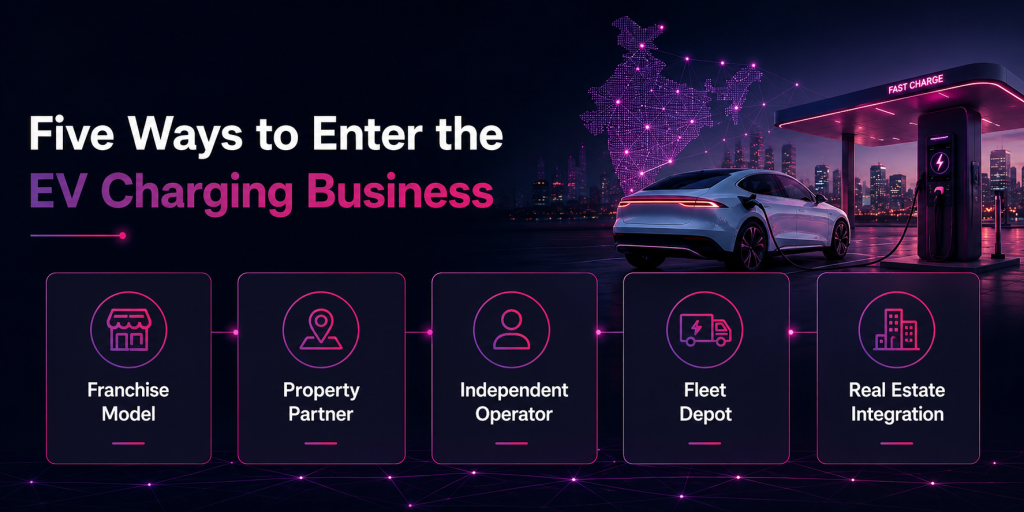
If you want to understand what entry model fits your situation — franchise, property partnership, or fleet depot — Procharge can help you work through the specific setup, location economics, and investment structure before you commit to anything.
Explore the Procharge franchise partner or property partner programme, or contact the team directly to start with a site assessment.
WhatsApp Us