How Much Does It Cost to Start an EV Charging Station in India? (2026 Full Breakdown)

ev charging station setup cost in india

How Much Does It Cost to Start an EV Charging Station in India? (2026 Full Breakdown)

This is one of the most common questions from anyone seriously evaluating an EV charging business. And it deserves a straight answer, not a vague range.
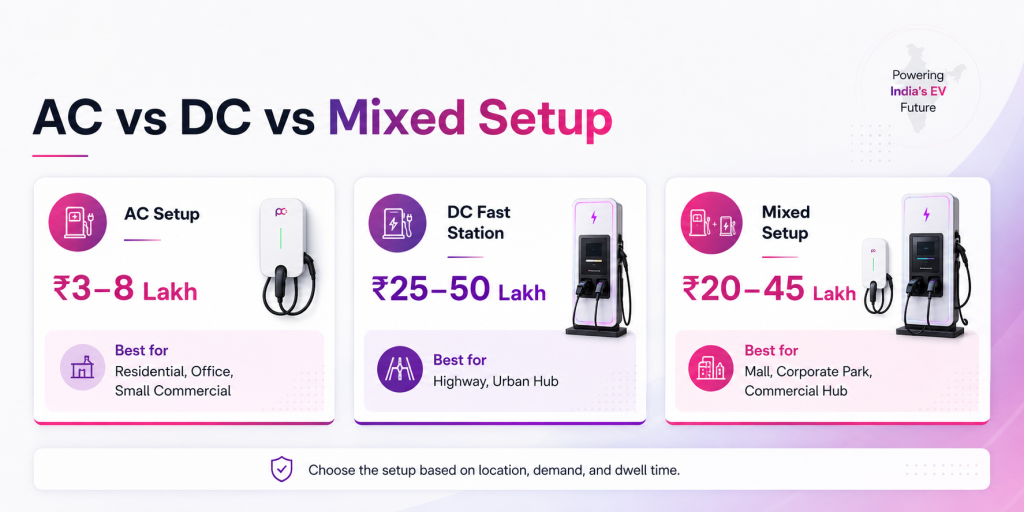
The honest answer is: it depends heavily on the charger type you install and the condition of your site. A basic AC setup at a housing society is a very different investment from a commercial DC fast charging hub on a state highway. Both are legitimate EV charging businesses. Both have different economics.
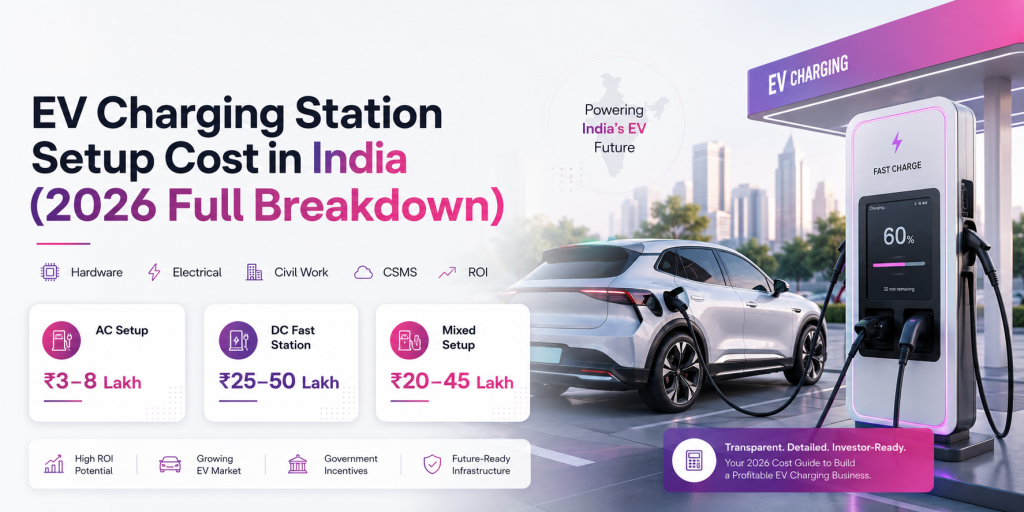
This guide breaks down the full cost — hardware, installation, electrical infrastructure, software, and operational expenses — for each major ev charging station setup type. It also covers what affects ROI and what a realistic payback timeline looks like in 2026.

The Cost Components You Need to Budget For

Most guides focus only on charger hardware price. That is the wrong starting point. The full setup cost of an EV charging station has five distinct components, and the charger itself often isn’t the largest one.

1. Charger hardware

The charger unit itself — the physical equipment that connects to the EV.

2. Electrical infrastructure

The DISCOM connection, transformer (if required), switchgear, MCB panels, cabling, and earthing. This is frequently underestimated and can equal or exceed the charger cost for DC fast charging setups.

3. Civil work

Site preparation, cable trenching, conduit laying, flooring or platform construction, protective bollards, shade structures, and bay marking. Costs vary significantly by site condition.

4. Software / CSMS

Charging Station Management System — the platform that handles remote monitoring, billing, user access, and session management. Without this, a commercial charging station cannot process payments or be managed at scale.

5. Operational costs (ongoing)

Electricity tariff, CSMS subscription or maintenance, site rent or revenue share, and periodic hardware servicing.

Now, the actual numbers.

 What About Government Subsidies?

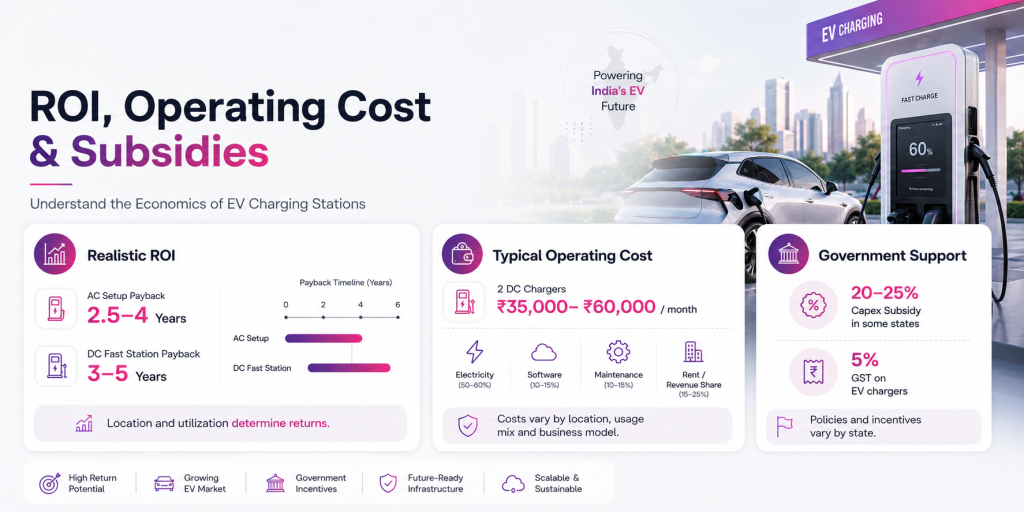
The PM E-DRIVE scheme and various state-level EV policies offer meaningful subsidy support that can reduce effective setup cost.

Under state schemes — Karnataka, Tamil Nadu, Maharashtra, and several others — capital subsidies of 20 to 25% are available on qualifying EV charging equipment, capped at specific amounts. Tamil Nadu’s policy offers a 25% capex subsidy for the first 50 private chargers, capped at ₹10 lakh per operator.

GST on EV chargers was reduced from 18% to 5%, directly reducing hardware procurement cost.

DISCOM security deposits may be waived or reduced under state EV policies for new charging connections.

Subsidy eligibility and availability changes with scheme timelines. Always verify current status with your state’s EV nodal agency before finalising investment calculations.

Realistic ROI: What the Payback Timeline Actually Looks Like

A frequently cited figure is two to five years payback for an EV charging station in India. That range is accurate — but the spread within it is large, and it almost entirely depends on utilisation.

For an AC charging setup at a high-footfall destination (mall, office, hotel):

At ₹8 lakh total setup cost, generating ₹15,000 to ₹25,000 per month net revenue after electricity and operating costs, payback is 2.5 to 4 years. This assumes steady utilisation from captive traffic at the host location.

For a DC fast charging station on a busy highway:

At ₹35 lakh total setup cost and ₹60,000 to ₹90,000 per month gross revenue at reasonable utilisation, payback is 3 to 5 years. Higher setup cost, higher revenue per session. Utilisation in the first year is typically lower than at a well-established station — this is where location selection is critical.

The utilisation number that makes the model work : Most analysts point to 30 to 50% daily charger utilisation as the target for a commercially viable station. Below 15 to 20% utilisation, the economics get difficult. Above 50%, the station is delivering strong returns.

Utilisation is almost entirely a function of location. A DC fast charger at a high-traffic highway junction that is the only option for 50 km in either direction will hit 40 to 60% utilisation within months. A charger in an obscure location with low EV traffic may run at 5 to 10% indefinitely.

This is why site assessment — understanding traffic count, competing charger density, and EV ownership in the catchment area — matters more than any other single decision in the EV charging business.

EV charging ROI

Common Questions from Investors


Can I start with a small AC setup and expand to DC later?

Yes, and this is often the smartest approach. Run AC for a year, understand your utilisation patterns and revenue, then add DC capacity where demand justifies it. Plan the electrical infrastructure for future DC expansion at the start — it costs less to run conduit and transformer capacity upfront than to retrofit later.


Is land cost included in these estimates?

No. If you own the land, great — that’s your primary competitive advantage. If you’re leasing, land cost is an additional variable that affects payback timeline significantly. The CPO property partner model eliminates this variable for the CPO entirely.


Do I need the same setup for two-wheelers and four-wheelers?

No. Two-wheeler and three-wheeler AC charging uses different connectors (Bharat AC-001 or basic sockets) and lower power. A two-wheeler focused setup is significantly cheaper — fixed sockets at ₹3,000 to ₹8,000 per bay, with the rider’s portable charger handling the conversion. If your location serves mixed vehicle types, plan separate bay zones.


What is the minimum investment to enter the EV charging business?

A genuine commercial setup starts at around ₹3 to ₹5 lakh for a two-charger AC station. Under a CPO franchise or property partner model, the minimum capital requirement can be structured differently depending on the partnership terms.


The Bottom Line


EV charging station setup cost in India in 2026 ranges from ₹3 lakh for a basic AC setup to ₹50 lakh-plus for a full commercial DC fast charging hub. The investment is meaningful — this is infrastructure, not a side project. But the margin structure and the policy environment support the business case clearly when the location is right and the setup is properly designed.


Getting the setup right — charger type matched to your location’s dwell time, electrical infrastructure sized for future scale, software that handles billing and monitoring from day one — is what separates a high-performing station from one that underdelivers.


Procharge works with franchise partners and property owners across India to design setups based on the specific realities of each location — actual traffic counts, DISCOM load availability, charger mix, and a realistic revenue model before any investment is confirmed.


If you want a proper cost and revenue picture for your specific location and setup type, speak with the Procharge team before you start procurement.