- contact@procharge.in
- Open Hours : Mon - Sat 10:00 AM - 06:00 PM
- +91 7010 040 060
Most articles about the EV charging business assume you want to actively invest — buy chargers, apply for licenses, manage operations. That is one model. But it is not the only one, and for a lot of property owners in India, it’s not the most practical one either.
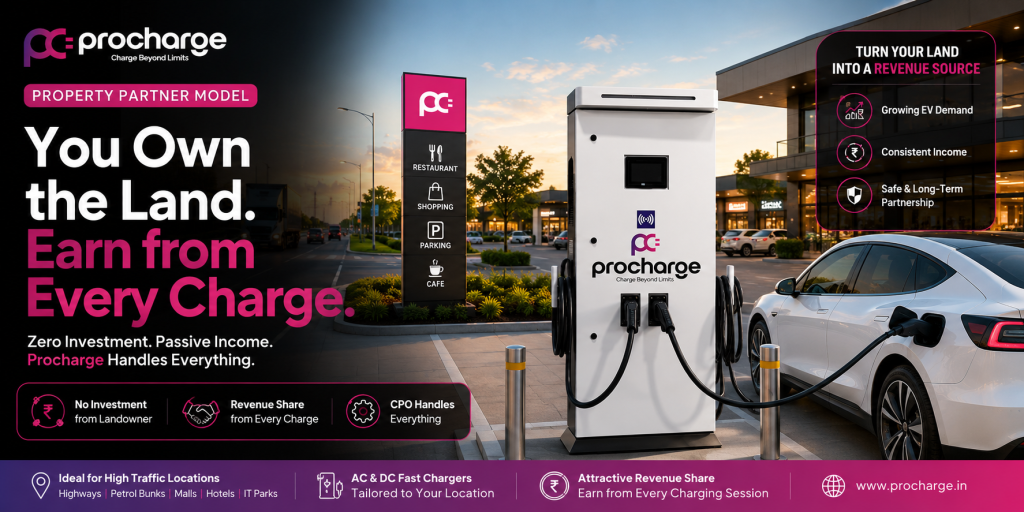
There is a different approach, and it’s becoming increasingly common across the EV charging industry. It goes by different names — property partner model, CPO land lease, revenue share hosting — but the core structure is the same: you provide the space, the CPO (Charge Point Operator) brings the chargers, handles everything operational, and you earn a share of the revenue from every charging session.
No capital outlay from your side. No charger procurement. No DISCOM applications. No software management. No maintenance calls. You own the land or the property, and it earns
This guide explains exactly how this works, what properties qualify, what kind of income is realistic, and what you should look for in a partner before signing anything.
What Kind of Property Works Best
Not every piece of land suits an EV charging station. The properties that generate strong, consistent revenue share for owners have a few things in common:
**High and consistent vehicle traffic.** A commercial plot on a state or national highway, a petrol bunk compound, a hotel or resort parking lot, an IT park, a mall or shopping complex, a large apartment complex — these locations have vehicles coming and going regularly. A residential plot in a low-traffic lane does not, even if the location is technically accessible.
**Adequate electrical infrastructure nearby.** The CPO needs to connect to a power supply. Properties with an existing commercial electricity connection, or within reasonable distance of a distribution transformer, are far easier to commission.
**Clear road access for vehicles.** EVs need to be able to pull in, park at the charger, and pull out without complex manoeuvring. A corner commercial plot with good frontage, a large parking compound, or a commercial complex with an organised parking layout all work well.
**Minimum space.** A single DC fast charger needs roughly one standard parking bay plus a safety clearance zone. A meaningful charging setup — say, four chargers — needs the equivalent of four to six parking bays. This is not a large space requirement.
If your property ticks most of these boxes, it is likely viable for an EV charging partnership.
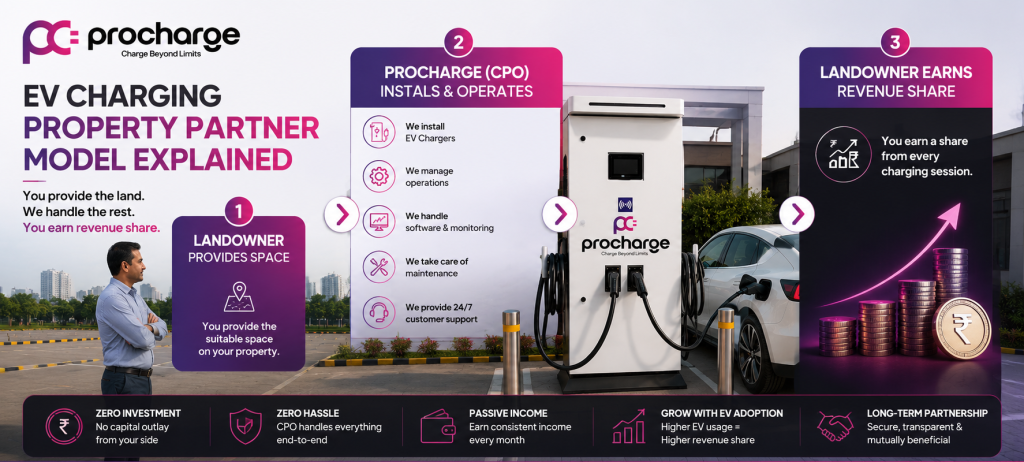
Fuel station owners are probably the clearest example of the property partner model working well in India. The land already exists. There is already a commercial electricity connection at the site. There is already consistent vehicle traffic. The fuel station compound has the space and the road access.
Under a CPO partnership, the fuel station owner provides a portion of the forecourt or compound. The CPO installs DC fast chargers (typically 30 kW to 60 kW for a public highway-facing station), manages the network, and handles all operations. The fuel station owner earns a per-kWh revenue share from every charging session, with no change to how the fuel business operates.
For a well-located fuel station on a busy state highway, this revenue share can add a meaningful monthly income line — particularly as EV adoption grows and utilisation rates climb over the next several years. HPCL and other major fuel retail networks have already signed large-scale CPO partnerships on exactly this model.
What About Commercial Plots Not on Highways?
Urban commercial plots — land adjacent to malls, markets, tech parks, or dense residential colonies — are equally viable, though the charger type and utilisation pattern is different.
An urban commercial plot near a residential cluster or commercial hub is better suited for AC destination chargers (7 kW to 22 kW), where vehicles park for two to four hours while owners shop, eat, or work. The revenue per session is lower than a DC fast charger highway stop, but session volume in a high-density urban location can be consistently high.
The property owner’s role is identical: provide the space, allow the electrical connection, and earn the revenue share. The CPO handles everything else.
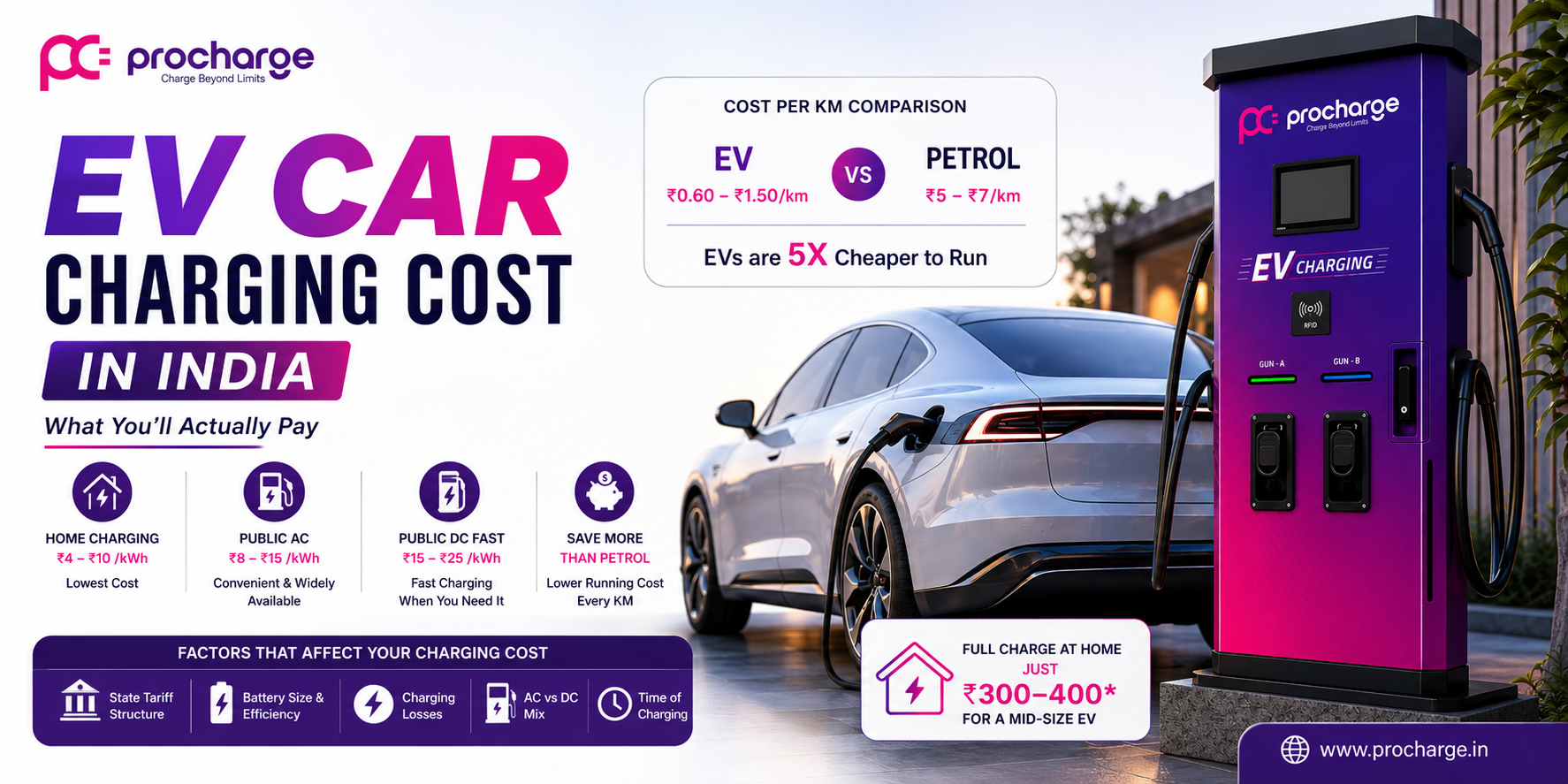
Revenue from EV charging is generated on a per-kWh basis. The CPO charges the EV driver a rate per kWh (typically ₹12 to ₹18 per kWh at public stations for AC, and ₹18 to ₹25 per kWh for DC fast charging as of 2026). From that revenue, the CPO pays electricity costs, operational overheads, and platform costs — and shares a portion with the property owner.
The exact split varies by CPO, property type, location quality, and charger count. Higher-traffic locations typically command a better revenue share percentage for the property, because the CPO’s business case is stronger.
What a property owner can realistically expect depends on charger utilisation. A well-located DC fast charger running at reasonable utilisation can generate ₹40,000 to ₹70,000 per month in gross charging revenue. The property owner’s share is a portion of that.
This is passive income — recurring, inflation-linked to electricity costs, and growing as EV adoption increases — from land that might otherwise be generating no income or underutilised rental income.
A property partner agreement with a CPO should cover a few non-negotiable items:
**Revenue share terms:** The percentage of gross charging revenue allocated to the property owner. This should be clearly defined, not buried in vague “performance-based” language.
**Term and exit conditions:** Most CPO-property agreements run for three to five years, reflecting the CPO’s charger investment timeline. Understand the exit terms if either party wants to end the arrangement.
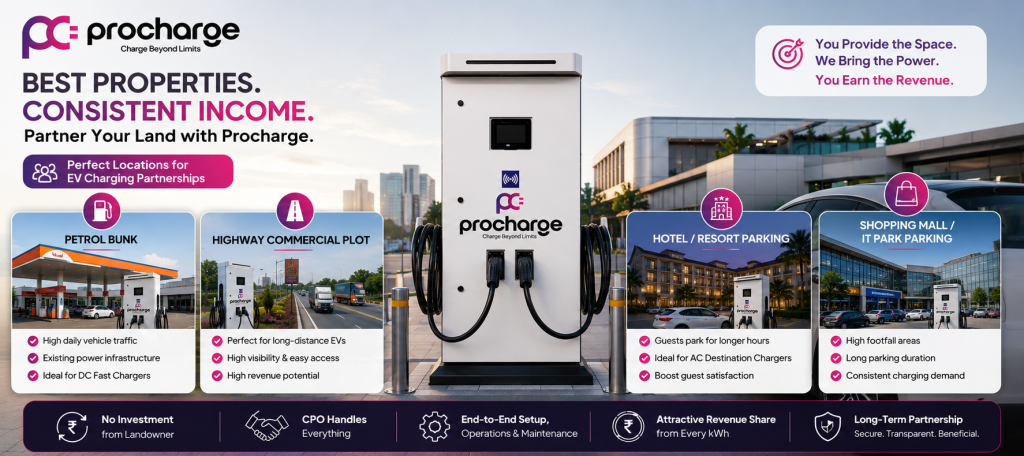
**Responsibility allocation:** The agreement should clearly state that the CPO is responsible for charger maintenance, software management, network monitoring, DISCOM billing for the charging connection, and user support. The property owner’s obligations should be limited to access and site security.
**Equipment ownership:** The chargers remain the CPO’s property during the agreement term. Understand what happens to the equipment at the end of the term.
**Uptime commitments:** A reliable CPO should commit to a minimum charger uptime percentage — typically 95% or above. Low uptime directly reduces your revenue share, so this matters.
Property partners frequently ask about things that the CPO handles entirely:
**DISCOM connection:** The CPO applies for and manages the commercial EV charging connection. You do not need to deal with your electricity board.
**Government licensing or registration:** EV charging is a de-licensed activity in India. No special licence is required, and the CPO handles all regulatory compliance.
**Charger maintenance:** A professional CPO monitors charger health remotely, dispatches maintenance on faults, and handles all servicing. You do not need to hire or manage any technical staff.
**User support:** EV drivers contact the CPO’s support line for any charging issues. You are not in the customer service loop.
**Civil work:** Charger installation, cable laying, safety signage, and bay marking are all the CPO’s responsibility.
Not necessarily. If you own a property in a genuinely high-traffic location and have the capital and operational interest, directly investing in a franchise model — where you own and operate the chargers — typically produces higher returns than a revenue share arrangement. You take on more operational involvement, but you capture more of the revenue.
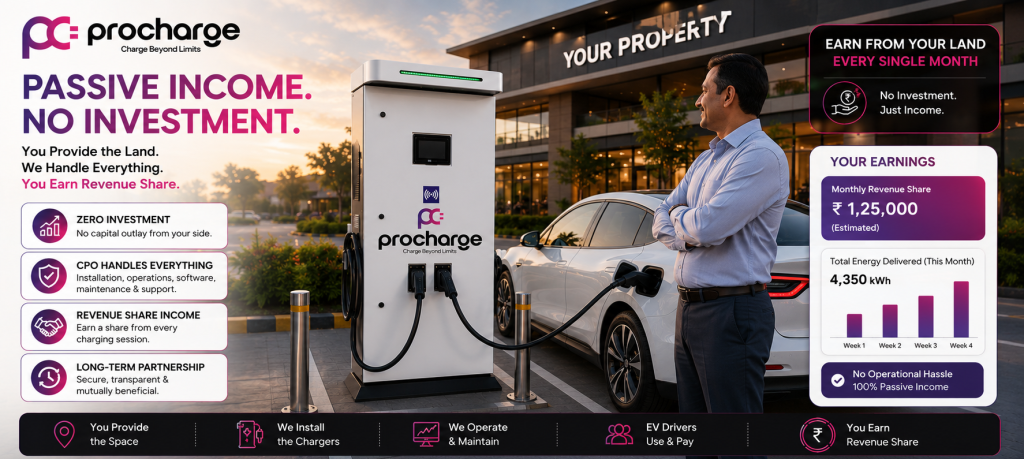
The property partner model is the right fit for owners who want passive income with no operational complexity, who do not want to tie up capital in EV infrastructure, or who own a property where the charger is a complementary service rather than the primary business.
The starting point is a site assessment — which any serious CPO should provide before proposing partnership terms. The assessment covers:
– Traffic count and vehicle profile at your location
– Electrical infrastructure availability and load headroom
– Space and access layout
– Competitive charger density in the immediate area
– Projected utilisation and revenue estimate
This assessment is what separates a realistic partnership proposal from a generic pitch. If a CPO is offering you a revenue share arrangement without ever visiting your site or assessing these factors, that’s a red flag.
Procharge works with landowners, commercial property owners, petrol bunk operators, hotel and resort owners, and industrial plot holders across India to evaluate EV charging partnership opportunities. The process starts with a site review — no commitment required — to understand whether your property is a viable EV charging location and what a fair revenue share arrangement looks like.
If you own land or a commercial property in a high-traffic location and want to explore whether an EV charging partnership makes sense, reach out to the Procharge Property Partner team.
WhatsApp Us