Plugging into Profit: Avoiding Common Pitfalls in EV Charging Franchises

EV charging franchise mistakes to avoid

Plugging into Profit: Avoiding Common Pitfalls in EV Charging Franchises

It’s easy to get excited about the EV charging station business model. The narrative is compelling: as electric vehicle adoption explodes, the infrastructure must follow, promising a lucrative, “future-proof” investment. Franchises offer a seemingly straightforward entry point—a proven system, a recognized brand, and a blueprint for success.

However, many ambitious entrepreneurs plunge headfirst into this surging current only to be caught in unexpected whirlpools. The reality is that the electric vehicle charging market is complex, capital-intensive, and operationally demanding. A template-based franchise approach doesn’t guarantee smooth sailing.

Let’s explore the most frequent pitfalls where new EV charging franchisees stumble, ensuring your investment electrifies, rather than blows a fuse.

The Foundation Trap: Underestimating Site Selection and Capital Requirements

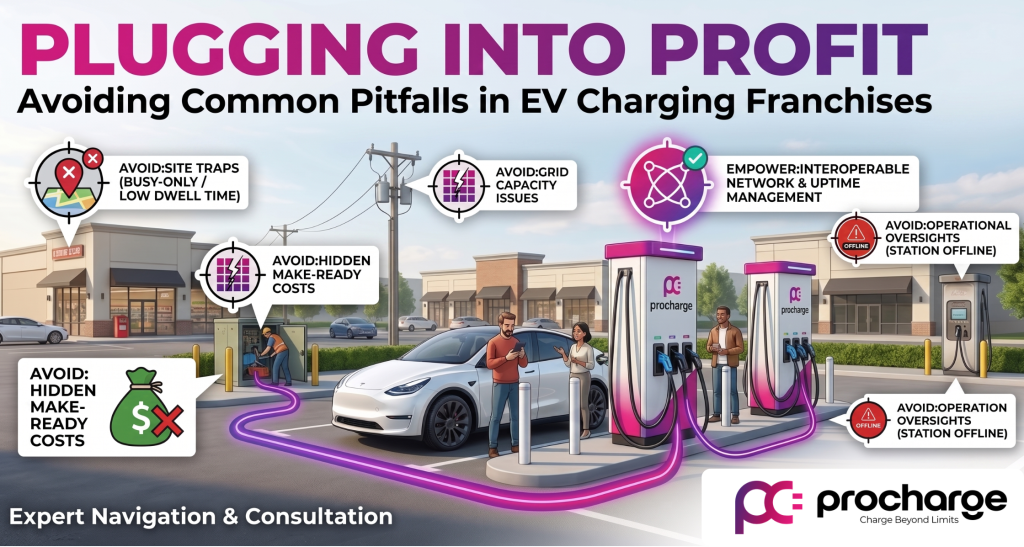
Many franchisees make the fatal mistake of treating EV charging like traditional retail, focusing solely on high-traffic areas or “good visibility.” This is mistake number one when choosing EV charging station locations.

Location, Dwell Time, and Grid Capacity

A brilliant location in a shopping center might be worthless if the average shopper only stays for 15 minutes. High-power DC fast chargers (DCFC), which are necessary for highway stops, require massive electrical utility capacity that many retail sites simply cannot provide without astronomical (and often deal-breaking) upgrade costs.

New franchisees often fail to conduct proper electrical load studies before signing a lease. The “best” location is often not the busiest, but rather the one with the optimal mix of dwell time (how long a car stays parked) and existing grid infrastructure, minimizing electric vehicle charging infrastructure challenges.

The True Cost of Entry

The second foundation trap involves EV franchise costs and ROI. The sticker price for a franchise fee and hardware is just the tip of the iceberg. New owners frequently underestimate:

  • Make-Ready Costs: The massive construction, trenching, and utility work required to bring high-power electricity from the grid to the chargers. This can easily double or triple the equipment cost.
  • Permitting and Delays: Regulatory hurdles for high-voltage installations can derail timelines by six months or more, bleeding capital before a single kilowatt is sold.

The Software Snag: Prioritizing Hardware Over Network Interoperability

The physical charger is only half the business; the network is the brain. A widespread mistake among new franchisees is prioritizing the lowest-cost hardware or a proprietary, “closed-loop” software system. In the modern EV landscape, EV charging network interoperability is paramount.

The Interoperability Imperative

EV drivers rely on a fragmented ecosystem of apps and RFID cards to find, access, and pay for charging. If your station requires a separate app, account, and pre-loaded balance just for your brand, you are creating massive friction. Drivers will bypass your station in favor of a network that works seamlessly with their existing accounts (like ChargePoint or EVgo roaming). Your network must “roam” with others. If it doesn’t, your utilization will suffer, a critical factor often overlooked when calculating operating costs for EV charging stations.

Ongoing Operational Oversight

Once the stations are in the ground, many franchisees assume the revenue just flows. This is when the real work of operation and frachisee common mistakes EV industry begins. Maintenance is critical. Hardware breaks, connectors are damaged, and payment systems fail. If your station is marked “offline” on driver apps for weeks, your brand and revenue are damaged. You need a dedicated maintenance plan and a proactive network provider—not just a salesperson—to manage uptime effectively.

Powering Your Future

The potential for EV charging remains enormous, but the “set it and forget it” mentality is a shortcut to failure. Success demands a rigorous approach to site selection, a realistic understanding of infrastructure complexity, and a long-term commitment to a flexible, interoperable network and dedicated uptime management.

Don’t let hidden costs and interoperability snags derail your ambition. The EV market moves fast—ensure your foundation is strong enough to handle the surge.

Need Help Navigating Your Franchise Journey?

Building a successful EV charging business requires expertise beyond the franchise manual. If you’re navigating location challenges, utility negotiations, or network selections, we can help. Contact us today for a free expert consultation.