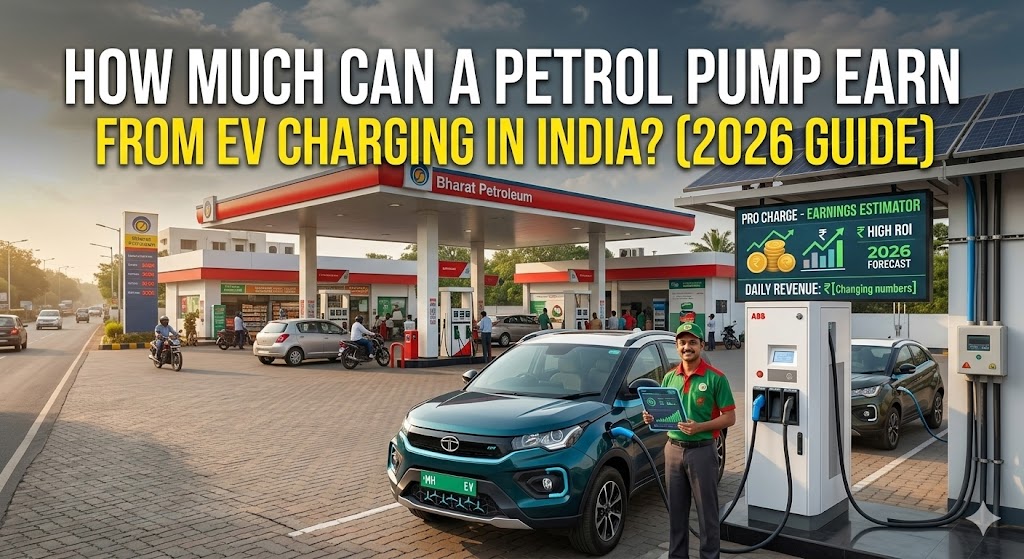
How Much Can a Petrol Pump Earn from EV Charging in India? (2026 Guide)
The Indian automotive landscape is hitting a massive tipping point. With the government’s PM E-DRIVE scheme (active through March 2026) and the push for 30% EV penetration by 2030, petrol pump owners are standing on a major opportunity.
But the question remains: Is it actually profitable?
If you own a retail outlet (RO) and are considering adding a DC fast charger, this guide breaks down the expected earnings, costs, and ROI in today’s EV charging market.
The Revenue Model: How Do You Make Money?
Unlike petrol, where margins are fixed per liter, EV charging income is based on the service charge added on top of the electricity cost.
1. The Per-Unit Margin
In most Indian states, DISCOMs provide electricity for EV charging at a concessional tariff of approximately ₹5.50 to ₹7.00 per kWh.
As a station owner, you typically charge customers between ₹18 and ₹24 per kWh.
Average Margin
₹12 – ₹16 per unit (kWh)
Daily Consumption
A typical 60kW DC Fast Charger can deliver around 400–600 units per day in high traffic locations.
Daily Gross Profit
Approximately ₹4,800 – ₹9,600 per day.
2. Ancillary Revenue (The Real Secret)
EV charging is not a quick process. Even with a DC fast charger, vehicles stay for around 30–45 minutes.
This dwell time creates additional earning opportunities for petrol pump owners.
Examples include:
QSR & Cafés
Selling coffee, snacks, and meals to waiting drivers.
Retail Stores
Impulse purchases from convenience stores like wildbean cafe or In&Out.
Advertising
Digital displays on charging stations can generate ₹5,000 – ₹10,000 per month in advertising revenue.
Projected Monthly Earnings: AC vs DC Chargers
Your earnings depend heavily on the type of charger installed.
AC Charger (7.4kW – 22kW)
Ideal For
Long-term parking and staff vehicles
Charging Time
6 – 8 hours
Average Monthly Revenue
₹15,000 – ₹25,000
Net Monthly Profit
₹8,000 – ₹12,000
DC Fast Charger (60kW)
Ideal For
Highways and busy city petrol pumps
Charging Time
45 – 60 minutes
Average Monthly Revenue
₹1,50,000 – ₹3,50,000
Net Monthly Profit
₹70,000 – ₹1,20,000
Note
These numbers assume a 20–30% utilization rate, which is the typical 2026 average for well-located pumps in Tier-1 cities and national highways.
Setup Costs and the PM E-DRIVE Subsidy
To calculate actual profits, the initial investment must also be considered.
1. The Investment
60kW DC Charger
₹15 Lakh – ₹25 Lakh depending on the brand and charging speed.
Infrastructure
Transformer installation, cabling, and electrical work can cost ₹3 Lakh – ₹5 Lakh.
2. The Subsidy Advantage
Under the PM E-DRIVE scheme, petrol pump owners can receive significant subsidies.
Up to 80% subsidy for charger hardware.
100% subsidy for behind-the-meter infrastructure such as transformers.
This can reduce the effective investment for a 60kW charger from around ₹25 Lakh to approximately ₹5 – ₹7 Lakh.
Top 5 Factors That Dictate Your Profits
Location
Petrol pumps located on busy corridors like Delhi–Jaipur or Mumbai–Pune can see up to 3 times higher utilization.
Fleet Tie-ups
Partnerships with EV fleets like BluSmart or Jio-bp pulse provide consistent charging demand.
Uptime Reliability
Industry data in 2025 showed that nearly 50% of chargers were often out of service. Maintaining 99% uptime builds customer trust and increases traffic.
Customer Experience
Clean washrooms, seating areas, and shaded waiting zones encourage drivers to stop at your station.
Visibility
Ensure your charging station appears on apps like Tata Power EZ Charge, PlugShare, and Google Maps.
Conclusion: Is It Worth It?
In 2026, EV charging at petrol pumps is not only about earning an additional ₹1 lakh per month.
It is also about future-proofing your petrol pump business.
As traditional fuel demand stabilizes in the coming years, EV charging will help petrol pumps evolve into modern mobility hubs for the next generation of drivers.
Sources and Further Reading
Ministry of Heavy Industries (MHI)
PM E-DRIVE Operational Guidelines (2024–2026)
NITI Aayog
Handbook for EV Charging Infrastructure Implementation
Economic Times
Report on over 27,000 EV chargers installed at petrol pumps by December 2025
Tata Power EZ Charge
Franchise business model and ROI guide
e-AMRIT Portal
Official state-wise EV electricity tariff data