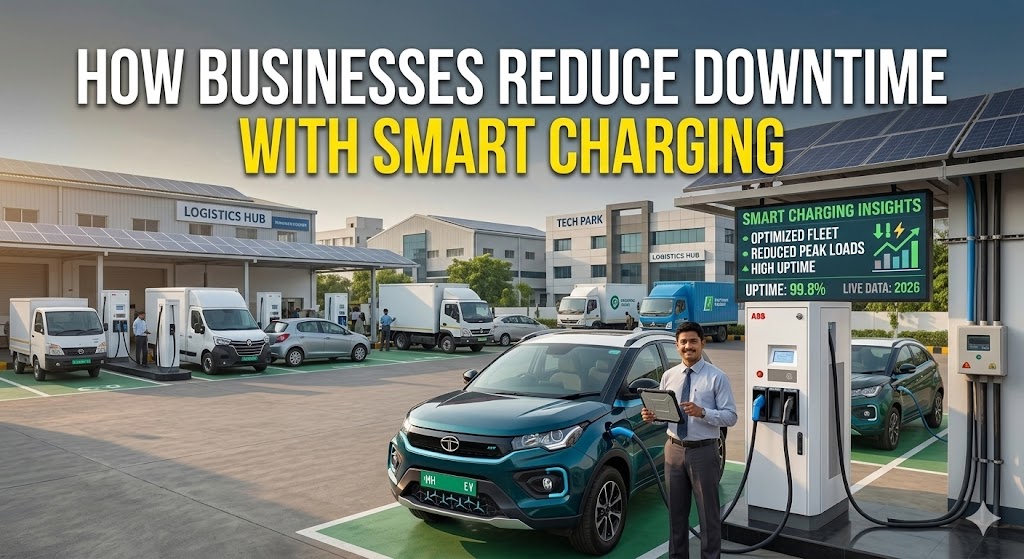
Fleet EV Charging: How Businesses Reduce Downtime with Smart Charging
For any commercial fleet, whether it is last-mile delivery, corporate car rentals, or heavy-duty logistics, a vehicle that isn’t moving is a vehicle that isn’t making money.
As India moves toward a 100% electric delivery mandate in several Tier-1 cities by 2030, the traditional fueling model is rapidly changing.
In 2026, the secret to operational efficiency is not just having enough chargers. It is Smart Charging.
Here is how modern businesses are using intelligent charging infrastructure to eliminate downtime and reduce operational costs.
The Downtime Dilemma in Fleet Electrification
During the early phase of fleet electrification, managers faced three major problems.
The Morning Rush
Everyone plugs in their vehicles at 6 PM. This often causes the local grid to overload, leaving many vehicles uncharged by 6 AM.
Peak Demand Charges
Charging dozens of vehicles at the same time triggers demand penalties from electricity providers (DISCOMs), reducing the cost savings of EV adoption.
Hardware Failures
If even one connector fails in a depot, it can affect multiple vehicles and disrupt daily operations.
Smart charging systems solve these problems by adding intelligent software control to the physical charging infrastructure.
1. Dynamic Load Management (DLM)
One of the biggest advancements in fleet charging technology in 2026 is Dynamic Load Management.
Instead of drawing the same amount of power for every vehicle, a smart system communicates with the building’s main electricity supply.
How it works
If the warehouse lights, elevators, and other equipment are using electricity, the charging system automatically reduces power to the chargers.
When the building’s energy demand drops at night, the chargers increase power output to charge vehicles faster.
Business Impact
This prevents expensive transformer upgrades and ensures that the total electricity consumption remains within the sanctioned limit, avoiding heavy penalties.
2. Priority-Based Charging Schedules
Not every vehicle in a fleet follows the same schedule.
Some delivery vans may leave at 4 AM for early morning deliveries, while others may leave at 9 AM for e-commerce operations.
The Smart Solution
Fleet managers can enter vehicle departure times into a Charging Management System (CMS).
The software then automatically prioritizes vehicles that need to leave earlier by allocating more power to them.
Result
There are no delays in dispatch times, and every driver begins their shift with a fully charged battery.
3. Remote Diagnostics and 99% Uptime
In modern charging networks, sending a technician to repair a charger is usually the last option.
Smart chargers now follow OCPP 2.0.1 standards, which allow remote monitoring and self-diagnosis.
How it works
If a charging session fails, the system can automatically reboot the charger or reset the communication module remotely.
Business Impact
This can reduce charger downtime by up to 70 percent. In many cases, issues are resolved before drivers even notice a problem.
4. Reducing Demand Charges with TOU Pricing
Electricity prices in India often vary depending on the time of day. This is called Time-of-Use (TOU) pricing.
Smart charging software automatically adjusts charging times based on these tariffs.
The Strategy
Charging is paused during expensive peak hours, typically between 6 PM and 10 PM.
Most charging activity is shifted to off-peak hours, usually between midnight and early morning.
Savings
Businesses have reported electricity bill reductions of 25 to 30 percent simply by shifting charging schedules.
Case Study: The 2026 Dark Store Model
Many quick-commerce delivery companies in India have adopted the micro-hub or “dark store” model.
These hubs use 30kW DC fast chargers combined with smart charging software.
Delivery bikes are charged during short waiting periods between orders, usually within a 10 to 15 minute window.
This method, known as opportunity charging, reduces the need for large battery swapping stations and lowers infrastructure costs.
Conclusion: Data is the New Fuel
For businesses in 2026, EV fleets are no longer just an environmentally friendly initiative. They are a data-driven operational advantage.
Smart charging systems do more than just recharge batteries. They provide valuable insights and analytics that help companies scale their operations efficiently.
If your business currently manages more than five electric vehicles, switching from basic charging plugs to a smart charging management system could be the most important investment you make this year.