How Charging Cost Is Calculated
Formula: Charging Cost = Battery Capacity (kWh) × Tariff (₹/kWh) × Loss Factor (typically 1.10–1.15)
Example: A 40 kWh battery charged at ₹8/kWh with a 10% loss factor: 40 × ₹8 × 1.10 = ₹352 for a full charge. Over a 250 km range, that’s roughly ₹1.40/km.
Home Charging: The Cheapest Option
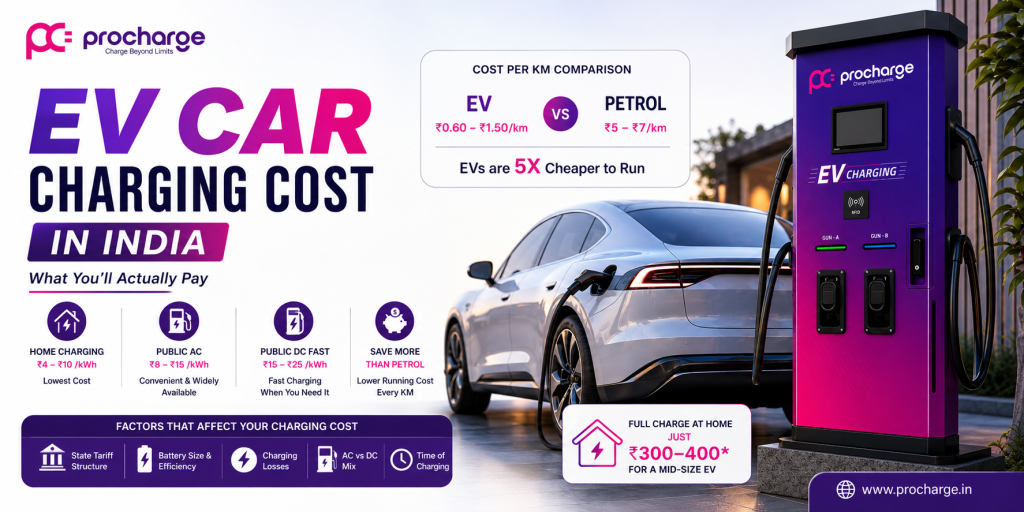
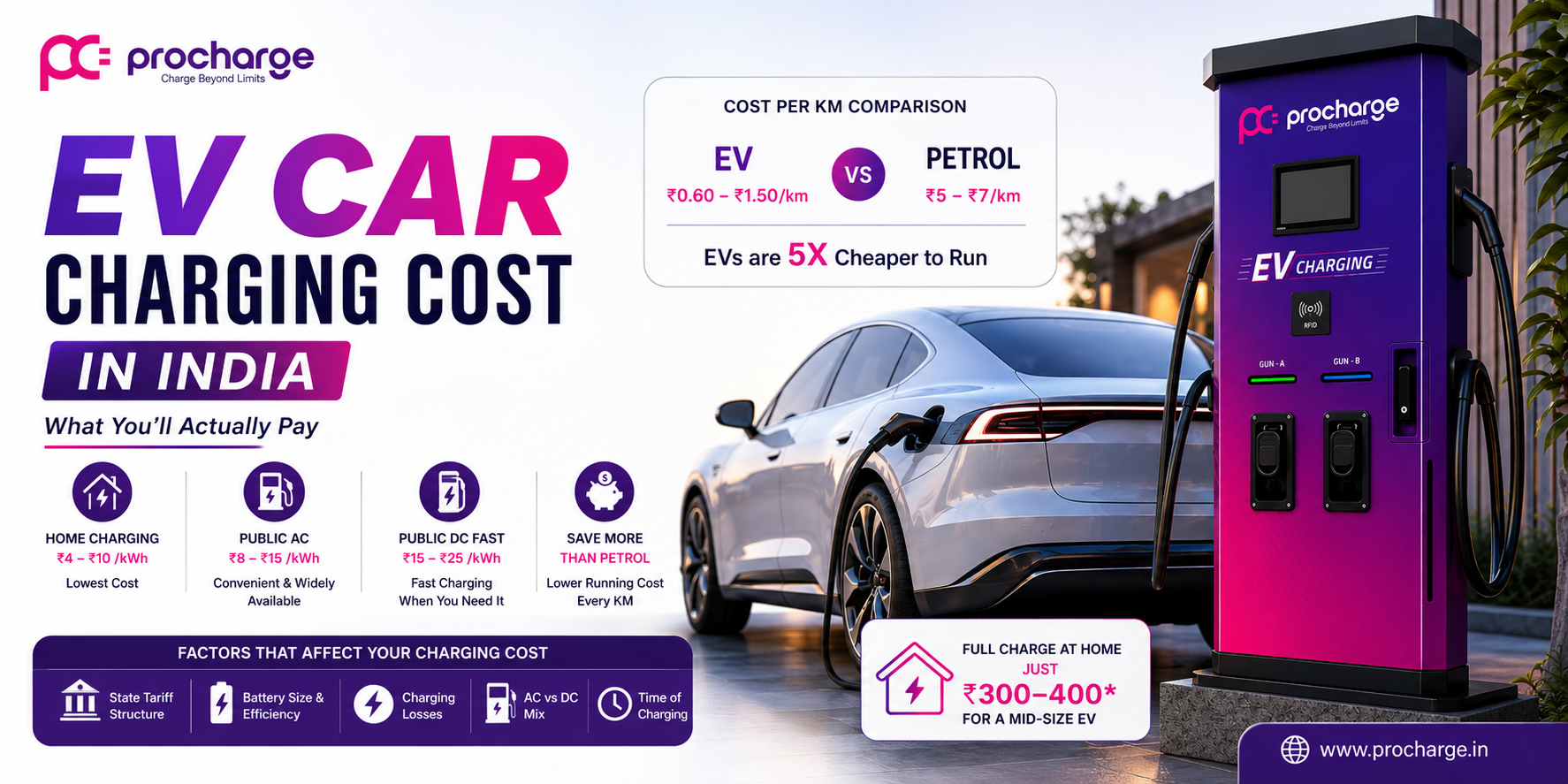
Most EV owners do 80–90% of charging at home. Domestic tariffs generally range from ₹4 to ₹10 per kWh, depending on state and DISCOM.
|
Battery Size
|
Tariff
|
Full-Charge Cost
|
|
25–30 kWh
|
₹6/kWh
|
₹165 – ₹200
|
|
40 kWh
|
₹8/kWh
|
₹350 – ₹380
|
|
50–60 kWh
|
₹9/kWh
|
₹500 – ₹600
|
Two things worth knowing: most states use slab-based tariffs, so adding EV charging load can push you into a higher slab, and some DISCOMs now offer dedicated EV meters/tariffs that keep charging costs separate from your household bill.
Public Charging: Faster, Pricier
Public operators price higher to cover infrastructure, maintenance, and service margins.
|
Charger Type
|
Typical Rate
|
|
Public AC
|
₹8 – ₹15/kWh
|
|
Public DC fast
|
₹15 – ₹25/kWh
|
|
Premium/highway DC
|
₹20 – ₹25+/kWh
|
A 40 kWh charge at ₹20/kWh public DC runs close to ₹880 — more than double the home-charging equivalent. You’re paying for speed, which makes sense for long trips but not routine daily use.
EV vs Petrol: The Real Comparison
|
Metric
|
EV (Home Charging)
|
Petrol
|
|
Cost per km
|
₹0.60 – ₹1.50
|
₹5 – ₹7
|
|
Cost per 1,000 km
|
₹600 – ₹1,500
|
₹5,000 – ₹7,000
|
Even factoring in occasional public fast charging for long trips, EVs typically stay well below petrol on cost per kilometre — often by 5x or more.
What Changes Your Actual Cost
- State tariff structure — slab-based pricing in states like Maharashtra, Tamil Nadu, and Delhi means your rate depends on total monthly usage
- Battery size and vehicle efficiency — km per kWh matters more than absolute battery size
- Charging losses — older equipment can exceed the standard 10–15% assumption
- AC vs DC mix — heavier reliance on public DC fast charging raises your average cost per km
- Time of charging — off-peak charging is cheaper where time-of-day tariffs apply
Tips to Lower Your Charging Cost
- Charge at home whenever possible — it’s consistently the cheapest option
- Check if your DISCOM offers a dedicated EV tariff or meter
- Use smart charger scheduling to shift charging to off-peak hours
- Reserve public DC fast charging for long trips or emergencies
- Consider rooftop solar if you own your property
- Track your actual efficiency rather than relying on manufacturer claims
Common Mistakes
- Defaulting to public fast charging for routine daily top-ups
- Assuming a flat per-unit rate and ignoring slab-based pricing
- Not checking for a dedicated EV connection where available
- Overlooking charging losses when estimating monthly cost
Home vs Public Charging
|
Home Charging
|
Public Charging
|
|
Lowest cost per kWh
|
Fast — ideal for long trips
|
|
Convenient overnight routine
|
No home charger investment needed
|
|
Requires upfront installation cost
|
Higher per-kWh rate
|
|
Not always available for apartment dwellers
|
Availability varies by location
|
Key Takeaways
- Home charging: ₹4–10/kWh; public charging: ₹8–25/kWh depending on AC or DC
- A mid-size EV’s full home charge typically costs ₹300–400; public DC fast charging can cost double
- EVs run at ₹0.60–1.50/km at home versus ₹5–7/km for petrol
- Tariff slabs, charging losses, and AC/DC mix all affect your real cost per km
Conclusion
Home charging is cheap and convenient for daily use; public charging costs more but buys speed when you need it. Once you understand your state’s tariff structure and your vehicle’s real-world efficiency, EVs consistently beat petrol on running cost — often by a wide margin, especially the more you rely on home charging.