- contact@procharge.in
- Open Hours : Mon - Sat 10:00 AM - 06:00 PM
- +91 7010 040 060
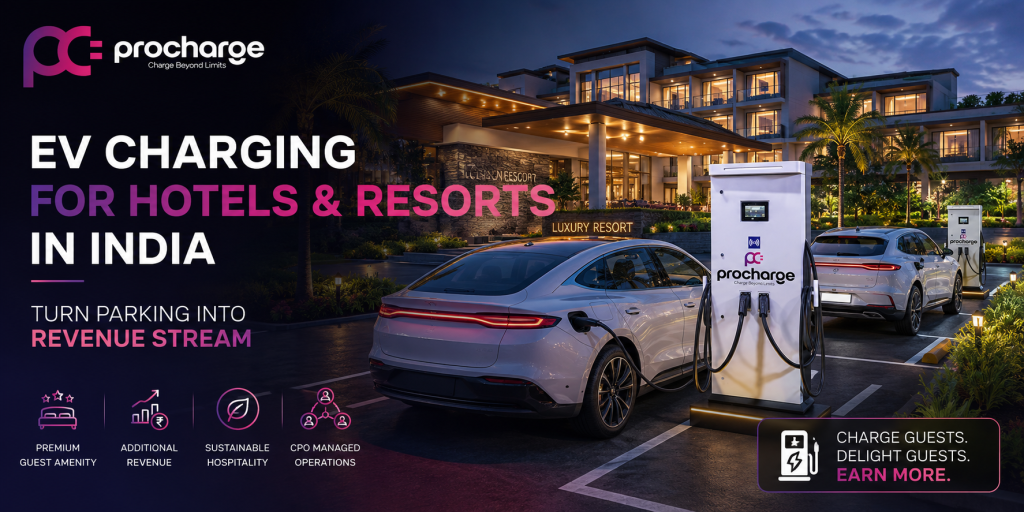
If you run a hotel, resort, or hospitality property in India, the conversation around EV charging for hotels is no longer about being “sustainable” or “future-ready.” Those are nice labels. The real question, for any property owner making infrastructure decisions, is simpler: can this make money? The answer, for well-located hospitality properties, is yes. And the mechanics are more straightforward than most hotel managers expect.
Destination charging — installing chargers at locations where guests park for extended periods — is gaining significant traction across India’s hospitality sector. The model works because the dwell time aligns naturally with charging time.
A guest checking into a city hotel parks overnight. An eight-hour stay with a 22 kW AC charger gives most EVs a complete charge. A highway resort guest stopping for lunch and a break parks for 60 to 90 minutes — long enough for a 30 kW DC charger to add 150 to 200 km of range. The car charges while the guest is already spending money at your property.
Compare this to a standalone public charging station, where the CPO has to attract drivers specifically to charge. A hotel doesn’t have that problem. The guest is already there.
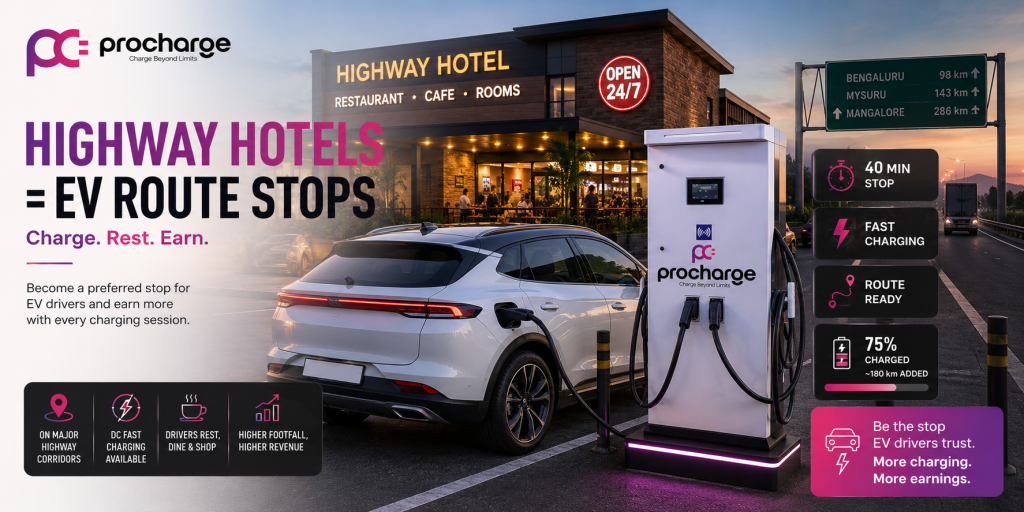
India’s national highway network is expanding rapidly, and EV road trips are becoming a real market as four-wheeler EV penetration grows. The challenge for EV drivers on long routes is predictability — knowing there is a reliable charger at a specific stop along the way.
A highway hotel or dhaba with one or two DC fast chargers becomes a mandatory stop on any EV driver’s route planning. That’s not an exaggeration. Long-distance EV drivers actively plan their routes around confirmed charger locations. If your property is at a logical stopping point on a major corridor — Chennai-Bengaluru, Pune-Mumbai, Delhi-Agra, for example — a visible, well-maintained DC fast charger on a CPO network puts your property on every EV route planning app used by drivers on that corridor.
What follows is straightforward: the driver stops to charge, spends 40 minutes at your restaurant or café, and you earn both the charging revenue and the food and beverage spend. Stations co-located with food service establishments consistently achieve 30 to 40% higher charger utilisation than standalone stations, precisely because the dwell time aligns.
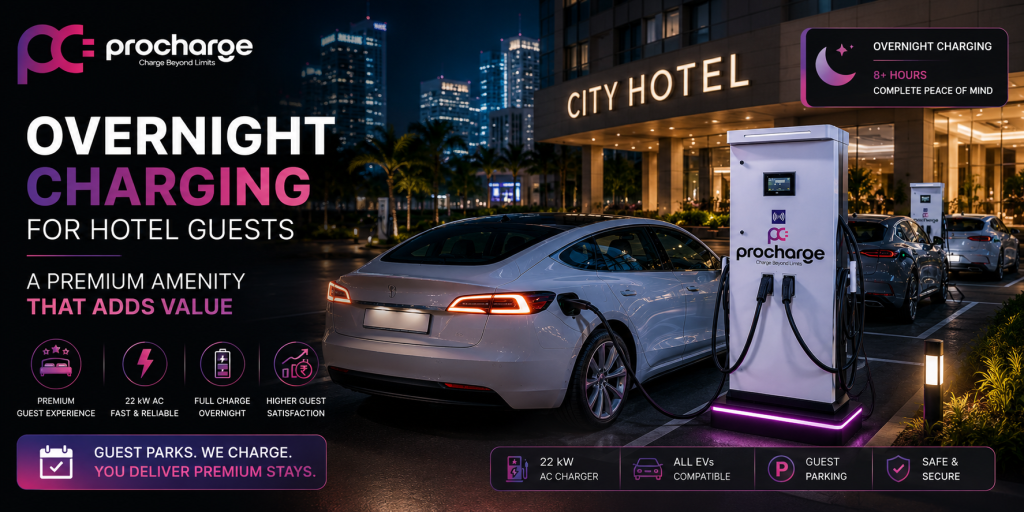
For city hotels and business properties, the model is different but equally compelling. Guests park overnight. AC chargers in the 11 to 22 kW range are the right choice — they fully charge most EVs during a standard overnight stay.
The reason to choose 22 kW over lower-powered options is flexibility. You do not control what EV your guests arrive in. Some cars charge at 7 kW, others at 11 kW, and newer models increasingly support 22 kW AC charging. Installing 22 kW units means you’re compatible with every current EV and every EV that comes to market over the next several years.
For a 50-room city hotel with a 30-car parking lot, starting with four to six AC chargers covers the realistic current demand and scales as the EV proportion of your guest profile grows.
Premium resorts face a slightly different situation. Guests stay longer — sometimes two or three days — and the EV profile of resort guests tends to skew higher-income, which correlates with higher EV ownership rates. For a luxury resort in Coorg, Ooty, Mahabaleshwar, or a beach property in Goa, having EV charging for hotels is increasingly an expectation, not a differentiator.
The practical note here: many resort guests arrive after highway travel and may need a meaningful top-up, not just a trickle charge. For longer-distance destinations, having at least one DC fast charger alongside standard AC units gives you the ability to serve guests who arrive with a depleted battery and want a reassuring charge before exploring the property.
This decision shapes your setup and your revenue.
**Paid per kWh:** The most common model for highway and commercial properties. Transparent, and EV drivers are accustomed to paying at public chargers. You set the per-kWh rate within your pricing discretion, earn on every session, and the revenue scales with utilisation.
**Free with room booking:** Some city hotels offer complimentary charging as part of the room rate — positioned as a premium amenity alongside Wi-Fi and parking. This works when charging is part of a rate-justified amenity package for higher-tier rooms, and the cost per session is a fraction of the room rate.
**Free with food purchase:** A smart model for highway restaurants and cafés. A minimum spend at the restaurant qualifies the guest for a free or subsidised charge. This drives F&B revenue directly tied to the charger’s presence.
The billing model affects your charger choice. Paid per kWh requires OCPP-enabled smart chargers with a management platform handling payment, access, and session tracking. Free or access-controlled models can work with simpler setups, though OCPP capability is still recommended for future flexibility.
Most hotel owners do not want to be in the electricity business. They want the benefit of EV charging for hotels property without managing firmware updates, user billing disputes, or maintenance call-outs.
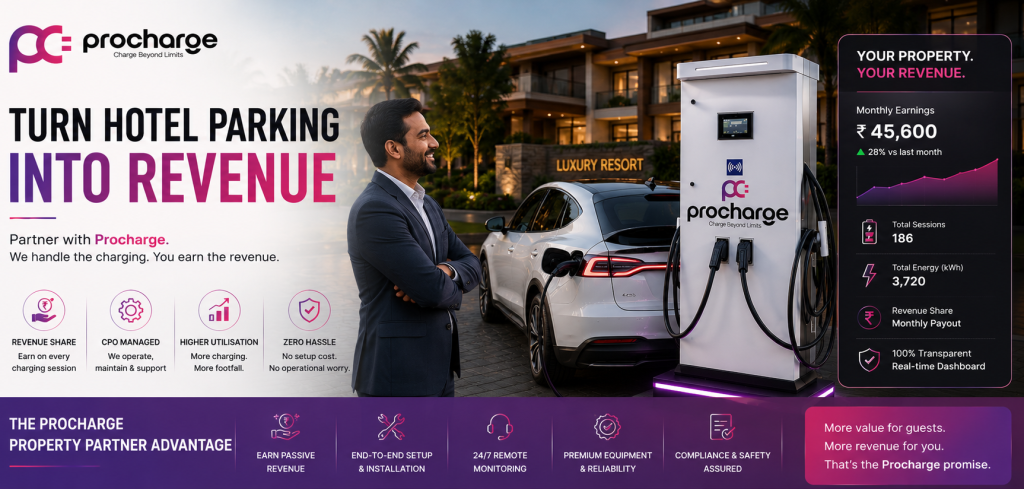
This is where a CPO partnership model makes practical sense. The CPO — a Charge Point Operator like Procharge — installs the chargers, manages the network platform, handles maintenance, and takes care of billing. The property provides the space and the electricity connection point.
Revenue is shared between the CPO and the property on a per-kWh basis. The property earns from every charging session without any operational involvement.
There is an additional benefit to this model beyond revenue: the hotel’s chargers appear on the CPO’s network app and on discovery platforms like Google Maps. EV drivers using the network actively find and route to your property. A highway hotel on the Procharge network becomes visible to every EV driver on that route using the app.
The practical steps for ev charging for hotels or resort property:
Electrical assessment : Check available load capacity and transformer headroom. Most hotels with commercial electricity connections have spare capacity to support four to eight AC chargers without a major upgrade.
Charger placement : Designate specific bays — ideally near the hotel entrance or in a visible section of the parking area. Clearly marked charging bays with proper signage improve utilisation significantly.
DISCOM connection : Apply for a commercial EV charging connection under the concessional EV tariff category. In metro areas, this connection should be processed within seven days.
Installation : Physical mounting, cabling, earthing, and commissioning. For a standard hotel setup of four to six chargers, this is typically a two to four day process.
Network integration : If partnering with a CPO, the chargers are connected to the network platform and begin appearing on discovery apps.
**Does the hotel need a separate electricity licence to charge guests?**
No. EV charging for hotels is classified as a service under Ministry of Power guidelines. No electricity distribution licence is required.
**What if the hotel has an older electrical infrastructure?**
A load study will confirm available capacity. Most commercial hotel connections have sufficient spare load for a modest initial setup. Load enhancement from the DISCOM is an option if demand grows.
**Can a hotel earn from EV charging even without a large parking lot?**
Yes. Even two or three well-placed chargers on a CPO network at a high-traffic property can generate consistent monthly revenue. The per-charger revenue scales with session frequency, not just charger count.
**Is highway charging viable for a smaller dhaba or roadside property?**
Absolutely. A single DC fast charger at a strategic highway location, partnered with a CPO, can transform a small highway property into a confirmed stop on EV route planning apps. The property earns from both the charging revenue share and the increased dwell time spend.
If you own or manage a hotel, resort, highway restaurant, or hospitality property and want to understand the charger setup, revenue model, and partnership terms that apply to your specific location, Procharge can help you work through it.
The right setup depends on your property type, parking capacity, guest profile, and highway or urban location. Getting those details right before installation makes the difference between a high-utilisation revenue asset and an underused piece of infrastructure.
Explore the Procharge Property Partner programme or contact the team directly to discuss your property’s EV charging opportunity.
WhatsApp Us