- contact@procharge.in
- Open Hours : Mon - Sat 10:00 AM - 06:00 PM
- +91 7010 040 060
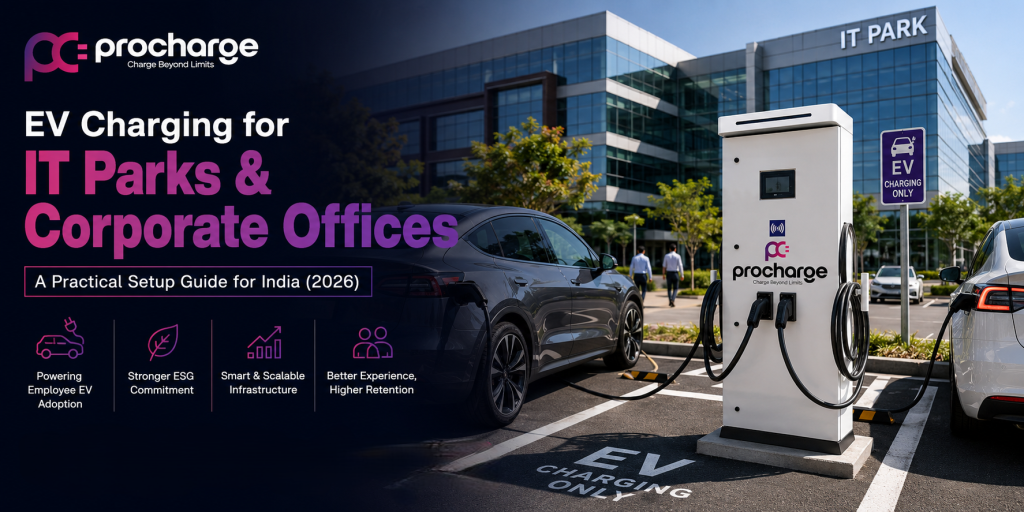
The parking lot conversation has changed at most large Indian IT campuses. A couple of years ago, if you spotted an EV charger in an office basement, it was probably a pilot project or an ESG checkbox item. Today, employees are asking for it before they buy their EVs — and facility managers are realising the answer can’t be “we’re looking into it” indefinitely. This guide is for facility managers, IT park developers, HR teams, and corporate real estate heads who want to move from intent to installation. Not a theoretical overview — a practical walkthrough of what workplace EV charging actually involves in India in 2026.
Most EV owners charge at home overnight. But a large chunk of the Indian EV-owning workforce — particularly in metro cities — lives in apartments without dedicated parking or where the housing society hasn’t yet enabled charging. For these employees, the workplace is the most reliable place to top up.
A 2022 KPMG analysis noted that the majority of charging for private EVs in India is likely to happen at home or at work using AC slow and medium chargers. Workplace charging addresses one of the most persistent hesitations about switching to an EV: “What if I can’t charge at home?” Removing that anxiety — by giving employees a guaranteed daytime charging option — directly accelerates EV adoption among your workforce.
For Bengaluru’s IT corridor specifically, office parking lots collectively host approximately 500,000 two-wheelers daily. A large percentage of those riders would consider switching to electric if reliable workplace EV charging were available. That’s not a small market.
Most large IT companies — Infosys, TCS, Wipro, HCLTech — have been installing or announcing workplace chargers for several years now, and this is increasingly tied to their net-zero and ESG commitments. Infosys integrates smart energy management systems with its EV charging network, ensuring optimal power distribution and minimising grid load. TCS has internally committed to expanding charging infrastructure across all major campuses.
But you don’t need to be an IT giant to make this work. Mid-size IT parks, standalone office buildings, and corporate campuses in cities like Chennai, Hyderabad, Pune, and Bengaluru can deliver the same employee-facing benefit at a fraction of the headline investment.
The distinction worth making here: ESG reports and ribbon-cutting ceremonies matter less than operational reliability. An office that installs six chargers, marks the bays clearly, and manages them with a decent CSMS (Charging Station Management System) delivers more real value than a campus that announces 50 chargers with no usage policy and a waiting list no one manages.
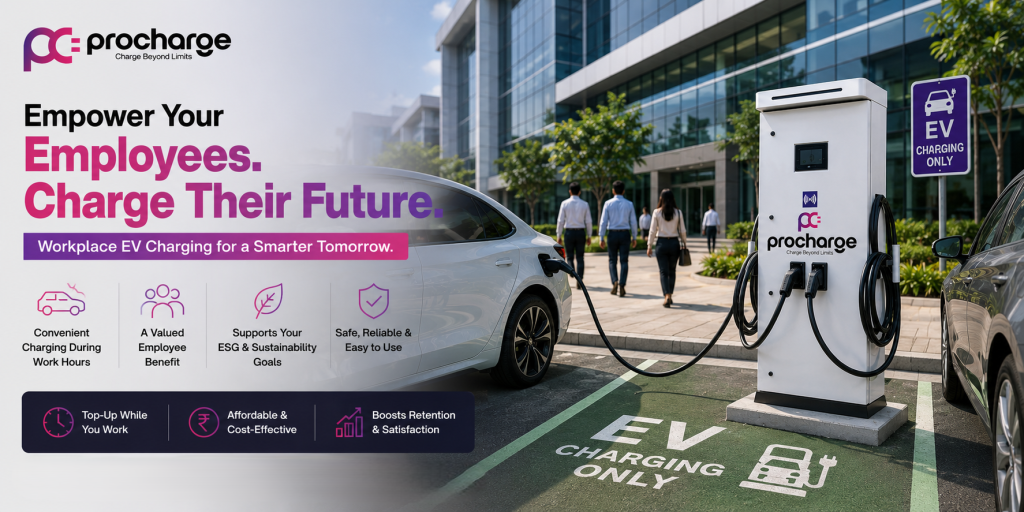
For employee parking — where vehicles sit for eight to ten hours during a workday — AC chargers in the 7 kW to 22 kW range are the right fit. A 7 kW charger adds roughly 40 to 50 km of range per hour. Even a partial four-hour charging window during the workday gives most employees comfortably enough for their commute home and more.
There is no reason to install a DC fast charger for employee parking. The car is sitting there all day. DC fast chargers are expensive, require far heavier electrical infrastructure, and in a workplace setting, the speed advantage is irrelevant.
The exception is visitor parking or client-facing spots. If your campus receives guests who only park for an hour or two and you want to offer a premium experience, a couple of 22 kW AC units or a single 30 kW DC charger at the visitor entrance makes sense.
For two-wheeler-heavy campuses (common in Bengaluru and Hyderabad tech parks), some companies are starting with even simpler setups — basic 3-pin sockets or low-power 3.3 kW chargers in covered two-wheeler parking, where employees use their own portable chargers. Very low cost, and it solves the problem for the majority of your EV workforce today.
There is no universal formula, but a reasonable starting point:
Look at your current employee count and estimate current EV ownership. In a 1,000-person campus, even a 5% EV ownership rate (50 people) means 50 vehicles needing charging. Not all of them will need to charge every day, and not everyone will arrive at the same time.
A practical rule: start with 10 to 20% of your expected EV demand in charger capacity, and plan the electrical infrastructure to scale. Installing conduit and running the wiring while doing the first phase is far cheaper than ripping up parking floors a second time.
Before committing to numbers, check your local building norms. Some states and municipal authorities have mandated that a certain percentage of parking in commercial buildings must be EV-charging-ready. If your building falls under such a regulation, that sets your minimum requirement.
This decision matters more than most facility teams realise, and it needs to be made before charger procurement.
If you offer charging free as an employee perk, you do not necessarily need OCPP-enabled smart chargers with billing capabilities. Non-OCPP chargers are simpler, more affordable, and easier to manage when billing is not involved.
If you want to charge employees for electricity used — even at cost — you need smart chargers with OCPP support and a management platform that handles access control, session tracking, and payments.
There is a middle position that some large campuses have adopted: charging is free during regular working hours as a perk, but after-hours use (evenings, weekends) is metered and billed at cost. This encourages employees to use chargers during daytime solar hours, reduces evening grid load, and keeps the system fair.
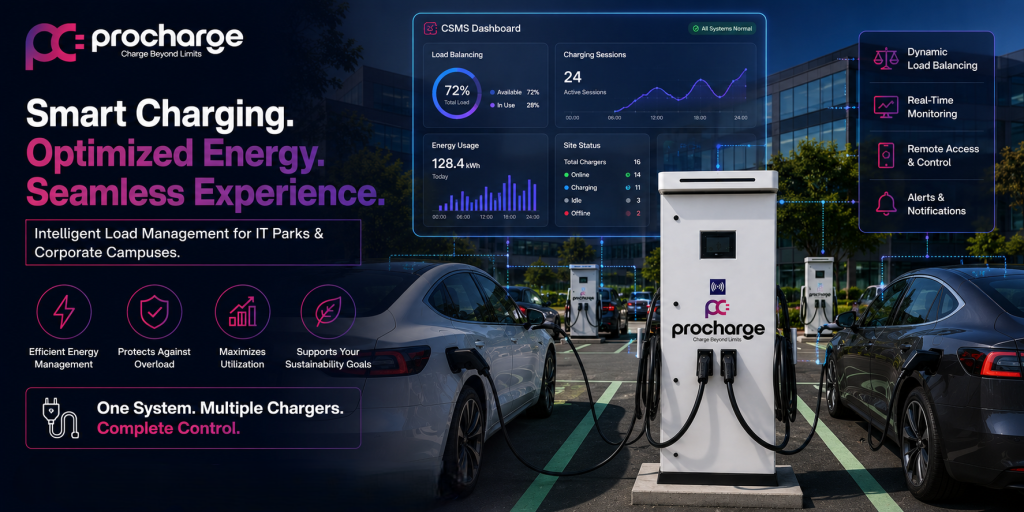
This is the part that catches most facility teams off guard. Multiple chargers running simultaneously create a significant electrical load. A campus with 20 x 7 kW AC chargers running simultaneously draws 140 kW — which may exceed your existing sanctioned load or trigger expensive demand charges.
Smart charging software with load balancing solves this. Instead of all 20 chargers running at full power simultaneously, the system staggers charging or reduces per-charger output based on total available load. The practical effect: more cars get charged, electricity bills are lower, and you do not need to upgrade the transformer to support peak simultaneous draw.
This is why OCPP-enabled chargers and a CSMS platform matter, even for a modest workplace setup. Without it, you are managing a system that will cause conflicts, complaints, and unexpected utility bills.
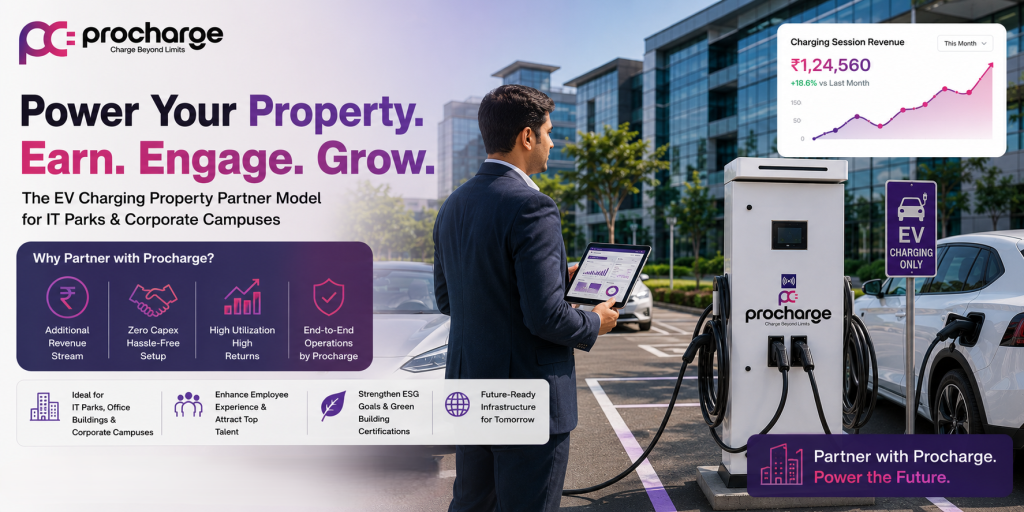
Beyond employee benefit, Workplace EV charging infrastructure adds real value to commercial real estate. For IT park developers and commercial property owners, charging-ready buildings command a premium in lease negotiations with large tech tenants who have ESG reporting requirements. Properties without charging infrastructure are increasingly at a disadvantage when competing for premium commercial tenants.
There is also a direct revenue angle. Under a CPO partnership model, the property owner provides space and electrical access, while the CPO installs and manages the chargers. The property receives a revenue share from every charging session. A large IT campus with high charger utilisation can generate meaningful monthly income from this model — with no operational responsibility for the property.
If you manage an IT park, office campus, or commercial building and are ready to move from planning to installation, the right first step is a site assessment — confirming your electrical capacity, the best charger positions in your parking layout, and the partnership model that makes the most sense for your property.
Procharge works with IT parks, corporate campuses, and commercial property owners to design, install, and operate workplace charging setups — including fully managed CPO partnerships where the property owner earns from charging sessions without taking on operational complexity.
Reach out to Procharge to discuss your property’s setup, charger count, and revenue model before you start procurement.
WhatsApp Us